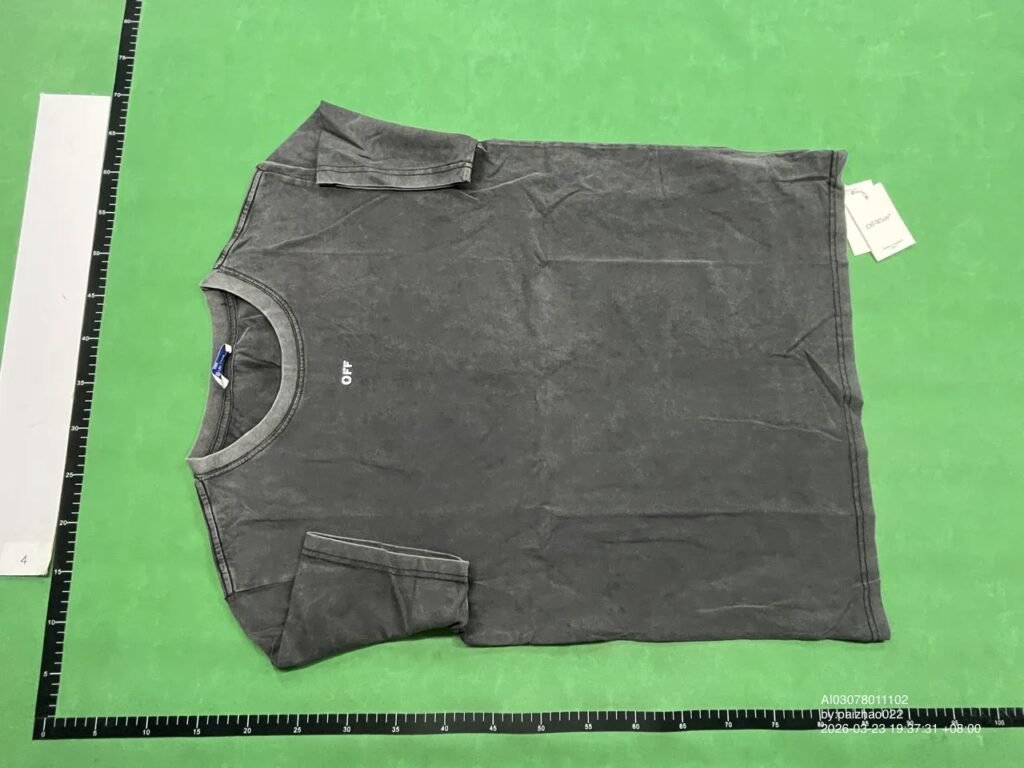
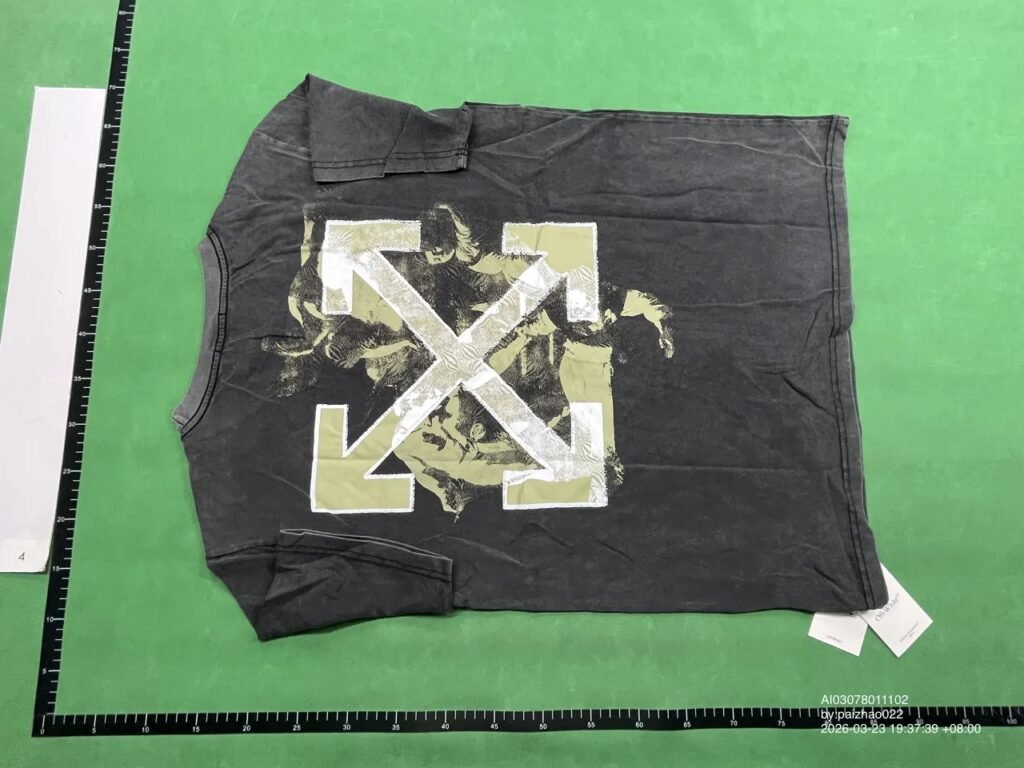
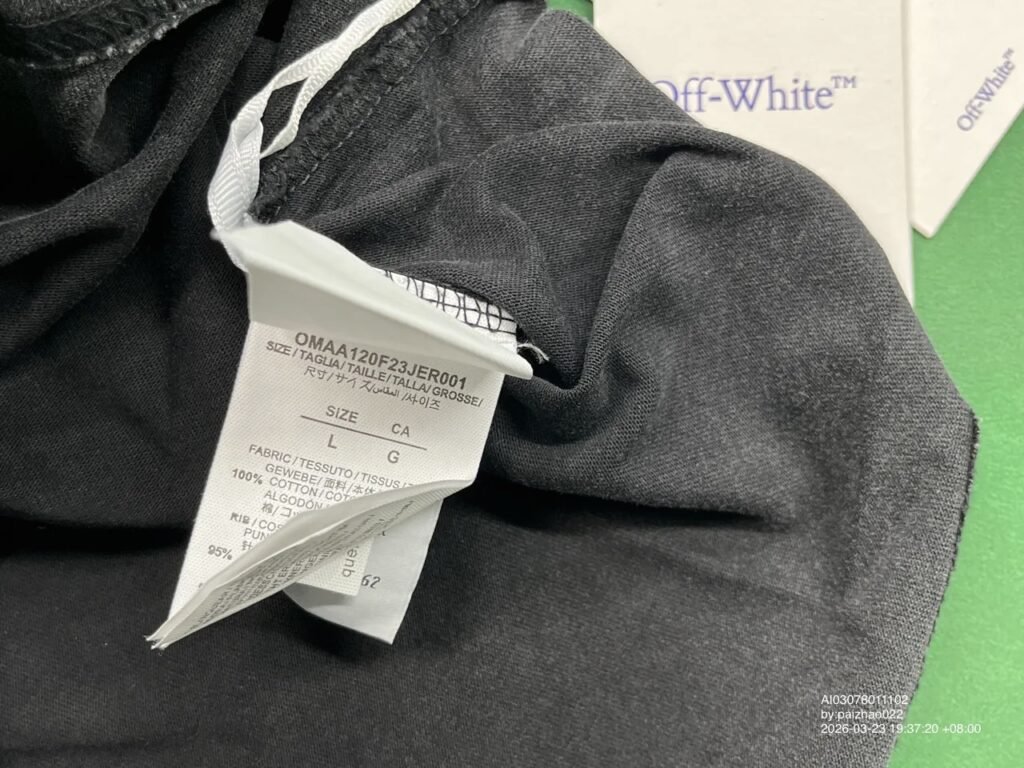
In response to the craftsmanship gap appearing in the replica market for Off-White brand items in Spring 2026, this report conducts a multi-dimensional analysis of samples collected under Litbuy platform’s standardized quality control environment (Green Screen QC Environment). It focuses on exploring the physical density of spray prints, the tensile elasticity coefficient of collar ribbing, and the logic for avoiding color distortion in optical environments.
I. Microscopic Granularity Assessment of Spray Print
In Off-White’s design language, “spray print” is not merely a pattern but a physical texture simulating street graffiti.Physical Characteristics: Top-tier batches (such as industry-recognized high-end suppliers) use high-viscosity thermosetting ink combined with atomized spray technology. In HD quality control images, the edges of the print should exhibit irregular, outward-diffusing “atomized particles,” not the sharp cut lines characteristic of screen printing.Tactile Characteristics: Authentic spray prints have subtle three-dimensional texture under natural light. If QC photos show excessively high surface flatness and lack necessary diffuse reflection effects, they can be judged as low-end generic batches. Such prints are highly prone to complete peeling or cracking after 3-5 standard washes.
II. Engineering Metrics of Ribbed Collar
The collar is not only a guarantee of garment longevity but also the physical demarcation point distinguishing basic shirts from high-end ready-to-wear.Warp-Weft Density: Standard Off-White T-shirt collars use 1×1 high-weight reinforced ribbing. Using the scale in QC images, users should precisely compare the stripe width and distribution density of the ribbing. High-quality batch collars exhibit excellent rebound performance under vertical force, typically being 15% thicker than ordinary commercially available T-shirts.Sewing Craftsmanship: Observe the flatlock stitching at the connection between the collar and shoulder seams. Top-tier craftsmanship requires stitch spacing to be constant within 2.5mm, with no significant thread protrusion. This is the core structure ensuring the Boxy Fit silhouette doesn’t collapse.
III. Optical Intervention: Color Accuracy Correction Logic in Green Screen Environments
The green screen background widely adopted by Litbuy, while convenient for system object recognition, causes severe optical shift for light tones and washed tones (Washed Grey).Chromatic Interference: The complementary color effect generated by the green background causes grey fabrics to appear purple-tinted or exhibit grey precipitation in photosensitive elements. When evaluating QC images, users must perform mental correction referencing a color chart or request 4K close-up reshoots under a “neutral grey background.”Light Source Consistency: When assessing print color, observe shadow projection direction to determine if the warehouse light source is photography lighting with a high color rendering index (CRI>90). If the light source is too harsh, it can cause the color depth of spray prints to be excessively diluted.
IV. Value-Added Protection Solutions in Cross-Border Supply Chains
In 2026, due to persistently high rates of rough handling in cross-border logistics, packaging strategies for such high-value printed items are crucial.Pressure Protection: Given the physical characteristics of Off-White spray prints, prolonged heavy pressure can cause displacement between ink molecules (i.e., “adhesion”). When submitting shipments on Litbuy, be sure to check “air column bag protection” and “moisture-proof vacuum sealing.”Customs Declaration Logic: When filling out declaration forms for such items with obvious brand characteristics, we recommend using the “fragmented declaration method.” Avoid directly using brand keywords; instead, use “Customized Graphic Tee” paired with non-integer amounts (e.g., $24.83) to avoid the increasingly stringent customs inspection risk controls of 2026.
V. Core Quality Control Checklist (QC Checklist)
Print Dimension: Do the edges have atomized points? Is particle distribution natural and uniform?
Structural Dimension: Does the collar ribbing have a substantial feel? Are shoulder seams reinforced?
Accessory Dimension: Does the font weight of the wash tag match the latest season? Is the sewing thread color the same as the main fabric?
Conclusion
Replica purchasing in 2026 has shifted from “gambling on luck” to “data-driven.” Obtaining high-weight links through the litbuy spreadsheet is merely the first step. True quality assurance comes from the ability to digitally analyze QC images. Reject blind trust in adjectives; only believe in rulers, proportions, and optical truth.
Litbuy Beginner’s Guide: A detailed guide covering the entire process from registration, browsing products and placing orders to after-sales service. It includes practical tips, frequently asked questions and instructions for using the mobile app.
2026 Summer Litbuy Heat-Avoidance Haul: If You Don’t Get These 5 Items Now, Your Summer Will Only Be Sweat-Drenched! 🥵 Stussy Linen T-Shirt Essentials T-Shirt Stone Island Cargo Shorts Pulling out those so-called “hot items” bought last year, collars loose like ruffles, hanging on hangers I feel embarrassed. 🙄 Really, begging everyone randomly browsing litbuy…
I’d like to share my money-saving tips for buying replica goods in China through proxy shopping platforms like Kakobuy, including how to choose a platform, compare prices, navigate the shopping process, and some practical tips.
In today’s era of booming cross-border e-commerce, Litbuy has become the go-to platform for countless fashion enthusiasts and savvy shoppers, serving as a bridge connecting global consumers with high-quality Chinese products. However, faced with a vast amount of product information and a complex shopping process, finding the right items efficiently, avoiding pitfalls, and ensuring a…
Man, I really went all out this time. Last month, while browsing the LitBuy spreadsheet, my finger slipped, and I ended up ordering 12 pairs of shoes. Looking back now, was I a little carried away at the time? But the moment I received the package, all my doubts vanished. That package weighed a full…
I’ve had that Balenciaga “Sunset Paris” T-shirt saved on Pinterest for ages. That oil painting texture is absolutely stunning. As for the price of the authentic version, it’s over 500 euros on the European official website—and with shipping costs, it’s just outrageous. In early March, I spotted a replica on Litbuy for less than a…